
What is Cognitive Dissonance? Full Guide & Examples
Cognitive dissonance explained: what it is, why it happens, the psychology behind it, real examples, and evidence-based ways to resolve it
 Berry Bits
·
July 12, 2026
·
15 min read
Berry Bits
·
July 12, 2026
·
15 min read
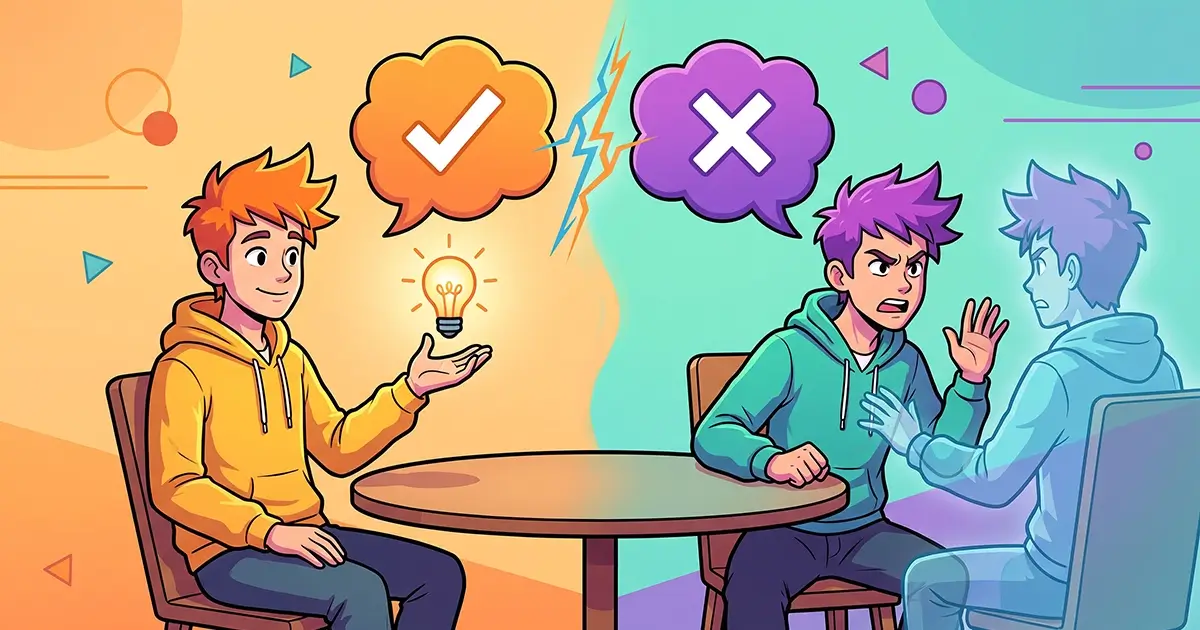
Have you ever kept using a product you knew was overpriced, just to justify the money you already spent? Or defended a decision you privately regretted? That uncomfortable mental tug-of-war has a name: cognitive dissonance.
It's one of the most quoted ideas in psychology, but also one of the most misunderstood. People throw the term around loosely, using it to describe any kind of inner conflict. The real concept is narrower, more specific, and honestly more interesting than the watered-down version most people know.
This guide breaks down what cognitive dissonance actually is, where it comes from, how it silently drives everyday choices, and four detailed examples that show it in action.
What Is Cognitive Dissonance, Exactly?
Cognitive dissonance is the mental discomfort a person feels when they hold two conflicting beliefs, values, or attitudes at the same time — or when their actions contradict their beliefs.
The term was coined by psychologist Leon Festinger in 1957. His theory was simple but powerful: humans have a deep need for internal consistency. When our thoughts and actions don't line up, it creates psychological tension. And because that tension is uncomfortable, we're motivated to reduce it, one way or another.
The key detail people miss is this: dissonance isn't just "feeling conflicted." It specifically involves a mismatch between belief and behavior, and it triggers an active drive to restore balance — even if that means changing the belief instead of the behavior.
Related Reads on Cognitive Dissonance:
Want to to go deeper on this topic? These guides cover more specific angles:
Why Does Cognitive Dissonance Happen?
At its core, dissonance happens because the mind treats consistency as a kind of psychological safety. Contradiction feels threatening, even when it's harmless on the surface.
Festinger's original research studied a doomsday cult whose prophecy failed to come true. Instead of admitting they were wrong, many members convinced themselves the group's faith had saved the world from destruction. Believing they'd wasted years of their life was far more painful than adjusting their story.
That's the essence of dissonance theory: when reality contradicts belief, the belief often bends before the behavior does.
How the Brain Tries to Resolve Dissonance
People generally use one of three strategies to reduce dissonance:
Changing the behavior. The most direct fix — align actions with beliefs. This is also the hardest, since it usually requires real effort or sacrifice.
Changing the belief. Easier and faster. Instead of quitting the behavior, the person adjusts their thinking to make it feel acceptable.
Adding a justifying belief. Rather than changing the original belief, the person adds a new one that outweighs the conflict, effectively rationalizing the gap.
Most people default to option two or three, because they require the least disruption to daily life. This is exactly why dissonance so often leads to self-justification rather than genuine change.
Cognitive Dissonance vs. Regular Doubt
It's worth separating dissonance from simple uncertainty. Doubt is not knowing which choice is right. Dissonance is discomfort after a choice has already been made, when the mind is scrambling to defend it.
This distinction matters because dissonance often shows up disguised as confidence. A person defending a bad decision loudly isn't necessarily sure of themselves — they may be working overtime to convince themselves as much as anyone else.
The Role of Effort and Investment
One detail that makes dissonance stronger or weaker is how much effort went into the original decision. Festinger's later research found that the more a person suffers or sacrifices for something, the more they end up valuing it afterward — a pattern sometimes called "effort justification."
This explains why grueling initiation rituals, harsh training programs, or expensive courses tend to produce fiercely loyal participants. If joining a group was easy, there's little dissonance to resolve. If it was painful, the mind needs a strong reason to justify that pain — and "this group is exceptionally valuable" is a much more comfortable conclusion than "I suffered for nothing."
The same logic applies in everyday consumer behavior. A product that was hard to get, expensive to buy, or embarrassing to ask for tends to be defended more fiercely than one that required no effort at all.
Dissonance and Selective Information
Another way the mind protects itself from dissonance is by controlling what information it lets in. This is closely related to confirmation bias — the tendency to seek out evidence that supports existing beliefs while avoiding evidence that challenges them.
Someone who has just bought a car, for instance, is statistically more likely to read positive reviews of that exact model afterward, and less likely to seek out negative ones. The purchase has already been made, so there's little upside to encountering information that would only create discomfort.
This selective filtering isn't necessarily conscious. It often happens automatically, through which articles get clicked, which conversations get engaged with, and which opinions get dismissed as "biased" or "not relevant."
Example 1: The Expensive Gym Membership

Somebody signs up for a premium gym membership, paying far more than a budget alternative down the street. Weeks pass, and they visit twice a month at best.
Rationally, this is a poor use of money. But admitting "I wasted my money" creates dissonance between the belief I make smart financial decisions and the behavior I'm paying for something I barely use.
Instead of canceling the membership (changing the behavior) or admitting the mistake (changing the belief), most people take the third route. They tell themselves things like "the equipment is nicer here," or "I'll start going more next month," or "at least it motivates me to feel guilty into going." These are dissonance-reducing stories, not evidence-based conclusions.
This is also why cancellation rates for gym memberships stay stubbornly low even among people who rarely show up. The membership itself becomes a symbol of intention, which feels better to keep than to lose.
There's also a timing element worth noting. Dissonance around a gym membership tends to spike right around the billing date each month. That's when the contradiction between "I'm paying for this" and "I'm not using it" becomes hardest to ignore, which is exactly when the justifications tend to get louder and more creative.
Example 2: The Smoker Who Knows the Risks

Few examples illustrate dissonance as clearly as smoking. Nearly every smoker is fully aware of the health risks. The belief smoking causes serious harm directly conflicts with the behavior I smoke daily.
Quitting would resolve the dissonance completely, but nicotine dependence makes that route difficult. So the mind reaches for softer resolutions.
Common justifications include "my grandfather smoked his whole life and lived to 90," "I'll quit before it becomes a real problem," or "stress is worse for my health than the cigarettes." None of these claims are being evaluated for accuracy — they're being selected for how well they ease psychological discomfort.
Public health campaigns that only present statistics often fail here, because dissonance isn't a knowledge gap. The smoker already knows the facts. What they lack is a low-cost way to reconcile those facts with continuing the habit, which is why behavioral interventions tend to outperform purely informational ones.
Interestingly, some smokers resolve the dissonance by shrinking their identity around the behavior rather than defending it outright. Phrases like "I'm only a social smoker" or "I don't smoke that much compared to other people" work by redefining the behavior itself, making it feel small enough that it no longer meaningfully contradicts the belief that they care about their health.
Example 3: The Loyal Customer of a Failing Brand

Someone buys a phone from a brand they've used for a decade. The new model has worse battery life, a buggy update, and mixed reviews. A friend using a competitor's device points this out directly.
Instead of agreeing, the loyal customer pushes back — defending features nobody asked about, downplaying the flaws, or insisting "you just don't understand how it works." This is dissonance protecting identity. The belief I make smart tech choices is tied closely to I am a [Brand] person, so criticizing the product feels like a personal attack.
Marketers understand this dynamic well, which is part of why brand loyalty programs, fan communities, and long-term ecosystems are so effective. Once someone has invested money, time, and identity into a brand, dissonance does a lot of the retention work on its own. Defending the purchase becomes easier than admitting a switch might have been smarter.
This is also why switching costs matter so much in retention strategy, even beyond the practical inconvenience of switching. Every year someone stays with a brand adds another layer of psychological investment, making the eventual dissonance of leaving even larger. Long-term customers aren't just staying out of habit — they're often staying because leaving would mean admitting years of loyalty were misplaced.
Example 4: The Employee Who Stays in an Unfulfilling Job

An employee dislikes their job — the pay is mediocre, the culture is draining, and growth has stalled. Yet they've been there for years and show no signs of leaving.
Friends and family often ask, "why don't you just quit?" But leaving would mean confronting a harder truth: years spent in a role that wasn't right. That's a heavier psychological cost than simply staying.
So the mind resolves the tension by inflating the positives. The employee starts emphasizing things like flexible hours, a short commute, or "at least I know what to expect." These aren't necessarily false — but they're being amplified specifically to justify staying, not because they objectively outweigh the downsides.
This pattern is sometimes called the sunk cost fallacy, and it's closely intertwined with dissonance. The more time or effort already invested, the stronger the pull to justify continuing, even when continuing isn't the rational choice.
Career coaches often see this play out in a specific way: the employee doesn't just defend the job to others, they start defending it internally, in the quiet moments where no one is around to convince. That's usually the clearest sign dissonance has taken over, since there's no external audience left to perform for — the justification has become genuinely believed rather than simply spoken.
How Cognitive Dissonance Shows Up in Everyday Life
Dissonance isn't limited to big life decisions. It quietly influences smaller choices too:
Choosing a restaurant based on a friend's recommendation, then insisting the meal was great even if it was mediocre, because admitting otherwise would mean the friend's judgment (and by extension, the relationship) is being questioned.
Buying a book that turns out to be disappointing, then forcing yourself to finish it "since you already started," rather than acknowledging the sunk time.
Supporting a political figure or team through a bad decision, not because the decision was good, but because switching sides feels like betraying a prior identity.
The common thread across all of these: dissonance shows up most strongly wherever identity, money, time, or public commitment is involved.
It's also worth noting that dissonance tends to intensify in public settings. A private regret is relatively easy to quietly let go of. A public one — a decision announced to friends, family, or an audience — carries the added weight of appearing consistent to others, not just to oneself. This is part of why people so often double down on opinions they've stated out loud, even after encountering evidence that should change their mind.
Cognitive Dissonance in Marketing and Persuasion
Understanding dissonance isn't just useful for self-awareness — it's a core tool in persuasion and marketing.
One well-known technique is the foot-in-the-door approach, where a small initial commitment (like signing up for a free trial) creates a mental thread of consistency. Once someone has taken that first small step, backing out later feels inconsistent with who they've already shown themselves to be.
Another is post-purchase reinforcement, where brands send confirmation emails highlighting how great the purchase was, specifically to reduce buyer's remorse before it can set in. This isn't accidental — it's a deliberate dissonance-reduction strategy built into the customer experience.
Even reviews and testimonials serve this function. Seeing others confirm a decision was smart helps offset any lingering doubt, reinforcing consistency between "I bought this" and "I made a good choice."
Loyalty programs work through a similar mechanism, but on a longer timeline. Points, tiers, and member perks aren't just rewards — they're reminders of ongoing commitment. Every time someone sees their accumulated points, it reinforces the belief that staying with the brand has been a smart, consistent choice, which makes switching to a competitor feel like it would waste that accumulated value.
Common Signs You're Rationalizing Instead of Reasoning
It helps to know the difference between a genuine explanation and a dissonance-driven excuse. A few patterns tend to give it away.
The justification changes depending on who's asking. If the reasoning shifts based on the audience, it's likely being tailored to sound convincing rather than to reflect the truth.
The explanation arrives instantly. Real reasoning usually takes a moment of genuine consideration. Justifications born from dissonance tend to come out fast, almost rehearsed, because the mind has already been quietly preparing them.
There's irritation when the decision is questioned. Mild curiosity is a normal response to a fair question. Defensiveness, on the other hand, often signals that the question is landing closer to an uncomfortable truth than the person would like.
Can Cognitive Dissonance Be a Good Thing?
It's easy to frame dissonance as purely negative, but it has a productive side too.
When dissonance pushes someone toward changing their behavior rather than rationalizing it, it becomes a catalyst for real growth. Someone who feels genuine discomfort about not exercising, despite valuing health, may eventually let that discomfort drive an actual lifestyle change rather than an excuse.
The difference between destructive and productive dissonance usually comes down to self-awareness. People who can notice the discomfort without immediately reaching for the easiest justification are far more likely to make decisions that hold up under scrutiny.
How to Reduce Unhealthy Dissonance in Your Own Thinking
A few practical habits can help:
Pause before justifying a decision instantly. The speed of a rationalization is often a signal of how uncomfortable the underlying conflict is.
Ask whether the justification would still make sense to a stranger with no stake in the outcome. If it wouldn't, it's likely serving the ego rather than the truth.
Separate the sunk cost from the current decision. Money or time already spent shouldn't be used as evidence for future choices.
Get comfortable with short-term discomfort. Sitting with the tension, even briefly, often leads to better decisions than immediately resolving it with a convenient story.
Write the decision down before defending it. Putting a choice into words, without an audience to perform for, tends to reveal whether the reasoning actually holds up or whether it only sounds convincing when said out loud.
Revisit old decisions occasionally with fresh eyes. Enough distance from the original investment can make it easier to evaluate a choice honestly, without the sunk cost clouding the judgment.
FAQs
What is a simple example of cognitive dissonance?
A common one is buying an expensive item and then convincing yourself it was worth every penny, even if you privately suspect it wasn't. The justification exists to ease the discomfort of the purchase, not to reflect the item's actual value.
Is cognitive dissonance the same as hypocrisy?
Not exactly. Hypocrisy is knowingly holding others to a standard you don't follow yourself, often without much internal conflict. Dissonance involves genuine psychological discomfort from an internal contradiction, even when no one else is watching.
What causes cognitive dissonance?
It's triggered whenever a belief and a behavior (or two beliefs) contradict each other, especially when the person has invested time, money, effort, or identity into one side of that contradiction.
How do you know if you're experiencing cognitive dissonance?
Common signs include feeling unusually defensive about a decision, avoiding information that challenges a choice you've made, or noticing you're offering justifications that even you don't fully believe.
Can cognitive dissonance affect relationships?
Yes. People often stay in relationships longer than they should because leaving would mean confronting the belief that time was "wasted," which feels more painful than staying and rationalizing the situation.
Is cognitive dissonance always a bad thing?
No. While it often leads to rationalization, it can also motivate real change when someone chooses to resolve the discomfort by adjusting their behavior instead of their beliefs.
How is cognitive dissonance used in marketing?
Marketers use it to reduce buyer's remorse (through reassuring follow-up messaging) and to build commitment gradually (through small initial asks that make bigger ones feel consistent later).
Does cognitive dissonance get worse with age or experience?
Not necessarily worse, but it often becomes more sophisticated. Older or more experienced individuals tend to have more elaborate justifications available to them, simply because they've had more practice defending past decisions.
Can two people experience the same event and have different levels of dissonance?
Yes. Dissonance depends heavily on personal investment. Someone with money, time, or identity tied to a decision will feel far more dissonance than a neutral observer looking at the exact same situation.
Final Thoughts
Cognitive dissonance isn't a rare psychological glitch — it's a constant, quiet force behind everyday decisions, big and small. From the gym membership nobody cancels to the job nobody quits, the same underlying mechanism keeps showing up: the mind protecting its own sense of consistency, even at the cost of accuracy.
Recognizing it doesn't make the discomfort disappear. But it does make it easier to tell the difference between a justification that's actually true, and one that simply feels better to believe.



Comments (0)
No comments yet. Be the first to share your thoughts!
Leave a comment
Your comment will appear after it's reviewed. Your email is never shown publicly.